



A website RFP (request for proposal) is a document you send to several developers or studios describing the site you need, so each can send back a price and a plan. A good one fits on two or three pages and covers ten things: who you are, the goal, the audience, the pages, the features, the content, the technical needs, the budget, the timeline and how you will choose. The website RFP template below covers all ten. Copy it into a document and fill it in.
We answer RFPs, so this is written from the other side: these are the questions we otherwise have to ask before we can quote.
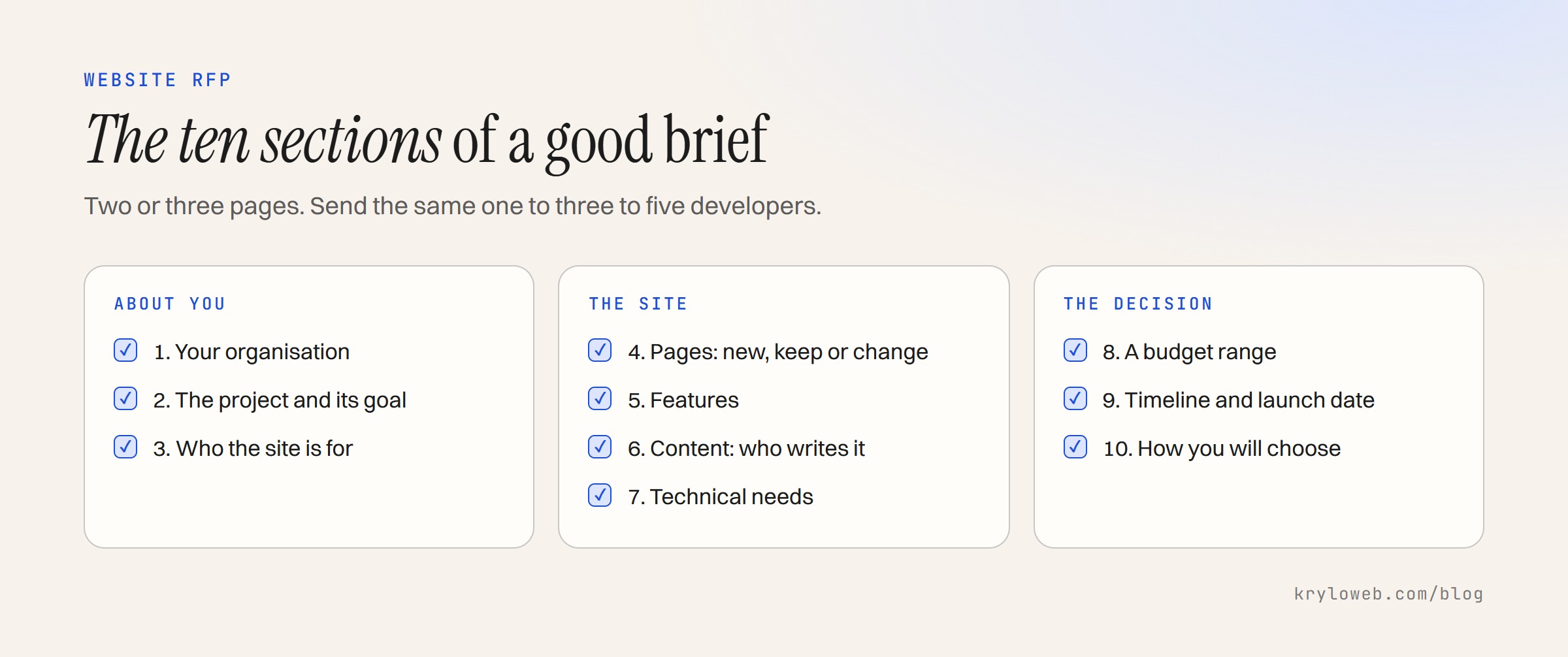
The website RFP template
1. About your organisation
Two or three sentences: what you do, where, and how big you are.
Example: We are a family-run physiotherapy clinic with two locations in Leeds and six practitioners. Most patients find us through Google or GP referrals.
2. The project and its goal
What you want built, and the one or two results that would make it a success.
Example: A redesign of our current site. Success means more online bookings and fewer phone calls asking the same questions.
3. Who the site is for
Your main visitors and what they come to do.
Example: Adults with injuries looking for a physio near them, mostly on phones. Second: GPs checking what we treat.
4. Pages
A list of the pages you need, marked new, keep or change. A sitemap sketch is ideal.
Example: Home, Treatments (one page per treatment, 8 in total), Locations (2), Team, Prices, Book, Contact, Blog (we have 30 posts to keep).
5. Features
What the site must do, beyond showing pages.
Example: Online booking connected to our existing booking system; contact form; Google Maps for each clinic; a blog we can update ourselves.
6. Content
Who writes the text and supplies photos, and whether existing content moves across.
Example: We will write treatment pages; we would like help editing them. We have recent photos of both clinics. All 30 blog posts move as they are.
7. Technical needs
Platform preferences, hosting, integrations, accessibility and legal requirements.
Example: No platform preference, but we must be able to edit pages ourselves. We own our domain and hosting. The site must meet WCAG 2.1 AA and UK cookie rules.
8. Budget
A range. Developers can only propose the right solution if they know what you can spend.
Example: £2,000 to £4,000 for the build, plus up to £100 a month for maintenance.
9. Timeline
When you can start, any fixed launch date and why.
Example: Start in March; launch before the end of May for a local campaign.
10. How you will choose, and what you want back
Your deadline for proposals, the questions you want answered, and how you will decide.
Example: Proposals by 14 February. Please include: price broken down by stage, what is excluded, timeline, who will work on it, two live sites you built, and what support costs after launch. We will choose on fit, clarity and price, in that order.
What makes an RFP work
Give a budget. Without one, you get proposals from $500 to $50,000 that solve different problems. A range doesn’t mean everyone quotes the top of it; it means the proposals are comparable.
Describe problems, not solutions. “Patients can’t find our prices” is more useful than “we need a pricing table with toggles”. Let the developer propose the solution.
Keep it short. Two or three pages are read carefully. Twenty pages are skimmed.
Ask the same questions of everyone. That is the point of an RFP. Our 12 questions to ask a web developer are a good set to include in section 10.
Be honest about what you don’t know. “We are not sure whether we need a redesign or a refresh” is fine. A good studio will help you decide; see redesign vs refresh vs rebuild.
Common mistakes
- No budget, so proposals can’t be compared
- A long list of features with no priorities
- Content left as “to be decided”, the most common cause of delays
- Asking for full design concepts before choosing a studio; good studios rarely do unpaid design
- Sending to twenty agencies; three to five is plenty
After the proposals arrive
Line the proposals up against your ten sections. Check what each excludes, who does the work, and what happens after launch, and compare each timeline with the steps in the web design process. Ask follow-up questions in writing. Then choose, and tell the others; they will appreciate it.
To get a sense of prices before you write your budget, read custom website design cost. When your RFP is ready, you’re welcome to send it to us.